Senin, 13 Maret 2023

Types of Computer Networks

1. PAN (Personal Area Network)
This type of network covers a smaller area, for example in offices and homes. Usually, many are used only for internet purposes, as well as printers. And does not require large resources to use the PAN network.

2. LAN (Local Area Network)
LAN network serves to connect network devices in conditions of relatively small coverage. Lan is one type of computer network that is commonly found. An example of implementing a LAN network is a network system at schools, offices, and homes. Many people tend to use certain connectivity, especially on token ring and ethernet. In addition, LAN also provides wireless network technology using WIfi and better known as WLAN (Wireless Local Area Network).

3. CAN (Campus Area Network)
CAN network can be said to have similarities with MAN, but is more limited in the scope of the campus or academia. For this network, it is mostly used for lab practice, e-mail, class updates, and so on.

4. MAN (Metropolitan Area Network)
MAN is a network that connects one computer device to another within the scope of the city on the same network. This type of network is larger than a LAN network.

5. WAN (Wide Area Network)
WAN is a collection of LANs that are geographically dispersed. WAN networks tend to use technologies such as ATM, X.25, and Frame Relay for even longer distance connectivity.

6. Internet
The Internet is the largest computer network ever created by humans. The scope of the internet covers almost all corners of the world. Anyone can access various sources of information on various computer devices, such as PCs, smartphones, laptops, tablets, TVs, and so on.

7. VPN (Virtual Private Network)
VPN is a solution to provide a more secure internet connection. VPN can create a secure path for data transmission needs. Currently, there are many platforms that sell VPNs for free, or provide premium access.

Sabtu, 11 Maret 2023

Fuzzy Logic (Trapezoidal Curves)

Fuzzy Logic (Trapezoidal Curves)

This is an image of a trapezoidal curve for fuzzy logic.

The highest value of fuzzy logic is 1 while the lowest value of fuzzy logic is 0.


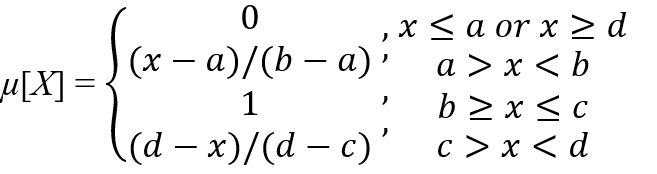
The formula to be used for the trapezoidal curve is as follows :


Explanation :

  • If the value of X is less than equal to a or greater than equal to d then the value is 0
  • If the value of X is greater than equal to b and less than equal to c then the value is 1
  • If the value of X is between a to b then the formula used is (x-a)/(b-a)
  • If the value of X is between c to d then the formula used is (d-x)/(d-c)


Notes :

  • If the result of the value of X is more than 1, then your calculation is wrong.
  • If the result of the value of X is less than 0, then your calculation is wrong.
  • The highest value of the result of the value of X is 1, while the lowest value of the result of the value of X is 0.


Kamis, 09 Maret 2023

Jenis-Jenis Jaringan Komputer

Jenis-Jenis Jaringan Komputer

1.    PAN (Personal Area Network)
Jenis jaringan ini mencakup wilayah yang lebih kecil, misalnya saja pada kantor, dan rumah. Biasanya, banyak digunakan hanya untuk keperluan internet, serta printer.

2.    LAN (Local Area Network)
Jaringan LAN berfungsi untuk menghubungkan perangkat jaringan dalam kondisi jangkauan yang relatif kecil. Lan merupakan salah satu tipe jaringan komputer yang umum dijumpai.
Contoh penerapan jaringan LAN yaitu sistem jaringan pada sekolah, kantor, maupun rumah.

Banyak orang yang cenderung menggunakan konektivitas tertentu, terutama pada token ring dan ethernet.
Selain itu, LAN juga menyediakan teknologi jaringan wireless dengan menggunakan WIfi dan lebih dikenal dengan WLAN (Wireless Local Area Network).

3.    CAN (Campus Area Network) 
Jaringan CAN dapat dibilang memiliki kesamaan dengan MAN, namun lebih terbatas dalam ruang lingkup kampus atau akademisi.
Untuk jaringan ini, lebih banyak digunakan untuk keperluan praktek lab, email, pembaruan kelas, dan lain sebagainya.

4.    MAN (Metropolitan Area Network)
MAN adalah jaringan yang menghubungkan antara satu perangkat komputer dengan perangkat yang lain dalam ruang lingkup kota pada jaringan yang sama. Jenis jaringan ini lebih besar dari dari jaringan LAN.

5.    WAN (Wide Area Network)
WAN merupakan kumpulan dari LAN yang tersebar secara geografis. Jaringan WAN cenderung untuk menggunakan teknologi seperti ATM, X.25, serta Frame Relay untuk konektivitas jarak yang lebih jauh lagi.

6.    Internet 
Internet adalah jaringan komputer terbesar yang pernah diciptakan oleh manusia. Ruang lingkup dari internet mencakup hampir seluruh penjuru dunia. Siapapun dapat mengakses berbagai sumber informasi dalam berbagai perangkat komputer, seperti PC, smartphone, laptop, tablet, TV, dan lain sebagainya.

7.    VPN (Virtual Private Network)
VPN merupakan salah satu solusi untuk menyediakan koneksi internet yang lebih aman. VPN dapat membuat jalur aman untuk kebutuhan transmisi data. Saat ini, banyak sekali platform yang menjual VPN secara gratis, maupun menyediakan akses premium.


Selasa, 07 Maret 2023

Fuzzy Logic (Down Curve)

Fuzzy Logic (Down Curve)

This is an image of the descending curve for fuzzy logic.

The highest value of fuzzy logic is 1 while the lowest value of fuzzy logic is 0.


The formula to use for the downward curve is as follows :


Explanation :

  • If the value of X is less than equal to a then the value is 1
  • If the value of X is greater than equal to a then the value is 0
  • If the value of X is between a to b then the formula used is (b-x)/(b-a)


Notes :

  • If the result of the value of X is more than 1, then your calculation is wrong.
  • If the result of the value of X is less than 0, then your calculation is wrong.
  • The highest value of the result of the value of X is 1, while the lowest value of the result of the value of X is 0.

Minggu, 05 Maret 2023

History of Computer Networks

History of Computer Networks

        The history of computer networks stems from the birth of the concept of computer networks in the 1940s in America which was initiated by a MODEL I computer development project at the Bell laboratory and a Harvard University research group led by professor Howard Aiken. At first the project only wanted to take advantage of a computer device that had to be used together. In order to work on several processes without wasting a lot of free time, a batch process was made, so that several programs could be run on a computer with a queuing rule.

        Then in the 1950s when the type of computer began to develop until the creation of a super computer, a computer had to serve several available places (terminals). So for the first time applied form of computer network . In a TSS system, several terminals are connected in series to a computer or other device connected to a computer network (host). In the TSS process, a combination of computer technology and telecommunications technology is beginning to be seen which initially developed independently. The American Department of Defense, the US Defense Advanced Research Projects Agency (DARPA) decided to conduct research aimed at connecting a number of computers to form an organic network in 1969. This research program became known as the ARPANET. In 1970, more than 10 computers were successfully connected to each other so that they could communicate with each other and form a network. And in 1970 , after the workload increased a lot and the price of large computer equipment began to feel very expensive, the concept of the distribution process began to be used (Distributed Processing). In this process several host computers do a large job in parallel to serve multiple terminals that are connected in series on each host computer. In the distribution process, it is absolutely necessary to have an in-depth integration between computer and telecommunications technology , because in addition to the processes that must be distributed, all host computers are required to serve their terminals in one command from the central computer.

        In 1972, Roy Tomlinson managed to complete the electronic mail program (email) that he made a year ago for the ARPANET. The program was so easy to use that it instantly became popular. In the same year, 1972, the at icon (@) was also introduced as an important symbol that shows "at" or "on". In 1973, the ARPANET computer network began to be developed outside the United States. Computer University College in London is the first computer outside America that is a member of the Arpanet network. In the same year, 1973, two computer experts, namely Vinton Cerf and Bob Kahn, presented a bigger idea, which became the forerunner of the idea of ​​the International Network (Internet). This idea was presented for the first time at the University of Sussex. The next historic day was March 26 1976, when the Queen of England managed to send an electronic letter from the Royal Signals and Radar Establishment in Malvern. A year later, it was already over 100 computers that joined the ARPANET to form a network or network.

        Tom Truscott, Jim Ellis and Steve Bellovin, created the first newsgroups called USENET (User Network) in 1979. In 1981, France Telecom created something new by launching the first television telephone, where people can call each other which is also associated with a video link.

        Along with the increasing number of computers that make up the network, a formal protocol is needed that can be recognized and accepted by all networks. For this reason, in 1982 a Transmission Control Protocol (TCP) or better known as the Internet Protocol (IP) was formed as we know it today. Meanwhile, in Europe appeared a similar network known as the Europe Network (EUNET) which covers the territory of the Netherlands, England, Denmark and Sweden. The EUNET network provides electronic mail services and USENET newsgroups.

        In order to standardize addresses on existing computer networks, in 1984 the Domain Naming System or domain name system was introduced , which we now know as DNS. Computers connected to the existing network have more than 1.000 computers. In 1987, the number of computers connected to the network jumped 10-fold to more than 10,000.

        Computer networks continued to grow. In 1988, Jarkko Oikarinen, a Finnish national, discovered and introduced Internet Relay Chat, or better known as IRC, which allows two or more computer users to interact directly by sending messages (chat). As a result, a year later the number of interconnected computers jumped 10 times. no less than 100000 computers form a network. The mid- 1990s were the most historic years, when Tim Berners Lee designing an editor and browser program that can explore one computer to another by forming a network. This program is called Waring Wera Wanua or the World Wide Web.

        Computers that are interconnected to form a network has exceeded a million computers in 1992. And in the same year the term surfing (exploring) appeared. And in 1994, the sites on the internet had grown to 3000 page addresses, and for the first time shopping via the internet or virtual-shopping or e-retail appeared on the site. In the same year Yahoo! was founded, which is also the birth year of Netscape Navigator 1.0.

Jumat, 03 Maret 2023

Fuzzy Logic (Rising Curve)

Fuzzy Logic (Rising Curve)

This is an image of an ascending curve for fuzzy logic.
The highest value of fuzzy logic is 1 while the lowest value of fuzzy logic is 0.


The formula to use for the rising curve is as follows:


Explanation :
  • If the value of X is less than equal to a then the value is 0
  • If the value of X is greater than equal to b then the value is 1
  • If the value of X is between a to b then the formula used is (x-a)/(b-a)

Notes :
  • If the result of the value of X is more than 1, then your calculation is wrong.
  • If the result of the value of X is less than 0, then your calculation is wrong.
  • The highest value of the result of the value of X is 1, while the lowest value of the result of the value of X is 0.

Rabu, 01 Maret 2023

Sejarah Jaringan Komputer

    Sejarah jaringan komputer bermula dari lahirnya konsep jaringan komputer pada tahun 1940-an di Amerika yang digagas oleh sebuah proyek pengembangan komputer MODEL I di laboratorium Bell dan group riset Universitas Harvard yang dipimpin profesor Howard Aiken. Pada mulanya proyek tersebut hanyalah ingin memanfaatkan sebuah perangkat komputer yang harus dipakai bersama. Untuk mengerjakan beberapa proses tanpa banyak membuang waktu kosong dibuatlah proses beruntun (Batch Processing), sehingga beberapa program bisa dijalankan dalam sebuah komputer dengan kaidah antrian.


    Kemudian pada tahun 1950-an ketika jenis komputer mulai berkembang sampai terciptanya super komputer, maka sebuah komputer harus melayani beberapa tempat yang tersedia (terminal), untuk itu ditemukan konsep distribusi proses berdasarkan waktu yang dikenal dengan nama TSS (Time Sharing System). Maka untuk pertama kalinya bentuk jaringan (network) komputer diaplikasikan. Pada sistem TSS beberapa terminal terhubung secara seri ke sebuah komputer atau perangkat lainnya yang terhubung dalam suatu jaringan (host) komputer. Dalam proses TSS mulai terlihat perpaduan teknologi komputer dan teknologi telekomunikasi yang pada awalnya berkembang sendiri-sendiri. Departemen Pertahanan Amerika, U.S. Defense Advanced Research Projects Agency (DARPA) memutuskan untuk mengadakan riset yang bertujuan untuk menghubungkan sejumlah komputer sehingga membentuk jaringan organik pada tahun 1969. Program riset ini dikenal dengan nama ARPANET. Pada tahun 1970, sudah lebih dari 10 komputer yang berhasil dihubungkan satu sama lain sehingga mereka bisa saling berkomunikasi dan membentuk sebuah jaringan. Dan pada tahun 1970 itu juga setelah beban pekerjaan bertambah banyak dan harga perangkat komputer besar mulai terasa sangat mahal, maka mulailah digunakan konsep proses distribusi (Distributed Processing). Dalam proses ini beberapa host komputer mengerjakan sebuah pekerjaan besar secara paralel untuk melayani beberapa terminal yang tersambung secara seri di setiap host komputer. Dalam proses distribusi sudah mutlak diperlukan perpaduan yang mendalam antara teknologi komputer dan telekomunikasi, karena selain proses yang harus didistribusikan, semua host komputer wajib melayani terminal-terminalnya dalam satu perintah dari komputer pusat.


    Pada tahun 1972, Roy Tomlinson berhasil menyempurnakan program surat elektonik (email) yang dibuatnya setahun yang lalu untuk ARPANET. Program tersebut begitu mudah untuk digunakan, sehingga langsung menjadi populer. Pada tahun yang sama yaitu tahun 1972, ikon at (@) juga diperkenalkan sebagai lambang penting yang menunjukkan “at” atau “pada”. Tahun 1973, jaringan komputer ARPANET mulai dikembangkan meluas ke luar Amerika Serikat. Komputer University College di London merupakan komputer pertama yang ada di luar Amerika yang menjadi anggota jaringan Arpanet. Pada tahun yang sama yaitu tahun 1973, dua orang ahli komputer yakni Vinton Cerf dan Bob Kahn mempresentasikan sebuah gagasan yang lebih besar, yang menjadi cikal bakal pemikiran International Network (Internet). Ide ini dipresentasikan untuk pertama kalinya di Universitas Sussex. Hari bersejarah berikutnya adalah tanggal 26 Maret 1976, ketika Ratu Inggris berhasil mengirimkan surat elektronik dari Royal Signals and Radar Establishment di Malvern. Setahun kemudian, sudah lebih dari 100 komputer yang bergabung di ARPANET membentuk sebuah jaringan atau network.


Tom Truscott, Jim Ellis dan Steve Bellovin, menciptakan newsgroups pertama yang diberi nama USENET (User Network) pada tahun 1979. Tahun 1981, France Telecom menciptakan sesuatu hal yang baru dengan meluncurkan telepon televisi pertama, di mana orang bisa saling menelepon yang juga berhubungan dengan video link.


    Seiring dengan bertambahnya komputer yang membentuk jaringan, dibutuhkan sebuah protokol resmi yang dapat diakui dan diterima oleh semua jaringan. Untuk itu, pada tahun 1982 dibentuk sebuah Transmission Control Protocol (TCP) atau lebih dikenal dengan sebutan Internet Protocol (IP) yang kita kenal hingga saat ini. Sementara itu, di Eropa muncul sebuah jaringan serupa yang dikenal dengan Europe Network (EUNET) yang meliputi wilayah Belanda, Inggris, Denmark, dan Swedia. Jaringan EUNET ini menyediakan jasa surat elektronik dan newsgroup USENET.


    Untuk menyeragamkan alamat di jaringan komputer yang ada, maka pada tahun 1984 diperkenalkan Sistem Penamaan Domain atau domain name system, yang kini kita kenal dengan DNS. Komputer yang tersambung dengan jaringan yang ada sudah melebihi 1000 komputer lebih. Pada 1987, jumlah komputer yang tersambung ke jaringan melonjak 10 kali lipat menjadi 10000 lebih.


Jaringan komputer terus berkembang pada tahun 1988, Jarkko Oikarinen seorang berkebangsaan Finlandia menemukan sekaligus memperkenalkan Internet Relay Chat atau lebih dikenal dengan IRC yang memungkinkan dua orang atau lebih pengguna komputer dapat berinteraksi secara langsung dengan pengiriman pesan (Chatting ). Akibatnya, setahun kemudian jumlah komputer yang saling berhubungan melonjak 10 kali lipat. tak kurang dari 100000 komputer membentuk sebuah jaringan. Pertengahan tahun 1990 merupakan tahun yang paling bersejarah, ketika Tim Berners Lee merancang sebuah program penyunting dan penjelajah yang dapat menjelajahi komputer yang satu dengan yang lainnya dengan membentuk jaringan. Program inilah yang disebut Waring Wera Wanua atau World Wide Web.


Komputer yang saling tersambung membentuk jaringan sudah melampaui sejuta komputer pada tahun 1992. Dan pada tahun yang sama muncul istilah surfing (menjelajah). Dan pada tahun 1994, situs-situs di internet telah tumbuh menjadi 3000 alamat halaman, dan untuk pertama kalinya berbelanja melalui internet atau virtual-shopping atau e-retail muncul di situs. Pada tahun yang sama Yahoo! didirikan, yang juga sekaligus tahun kelahiran Netscape Navigator 1.0.